

Non-Material Defense as a Strategic Dimension of National Resilience in the Era of Modern Warfare
Conceptual Defense Illustration
Jakarta, May 20, 2026
By:Brigadier General (Ret.) MJP Hutagaol ’86
INTRODUCTIONWHEN WAR MOVES INTO THE INVISIBLE SPACE
The world is undergoing a major transformation in the way threats operate against a nation.
In the past, threats were commonly associated with military invasion, territorial seizure, and armed force. Today, however, threats move in far subtler ways. They penetrate through information space, digital systems, economic structures, and even human consciousness itself.
A nation today can be destabilized not only by open warfare, but also by the collapse of public trust, the erosion of social morality, manipulation of perception, societal polarization, technological dependency, uncontrolled exploitation of resources, and disinformation that fractures national unity.
This transformation demonstrates that modern threats are no longer entirely physical.
It is within this context that national defense must be reinterpreted in a broader and more contemporary manner.
National defense can no longer be understood solely as the ability to confront military attacks, but also as the ability to preserve national awareness, collective morality, social stability, public trust, and the balance between humanity and its living environment.
Within this framework, the concept of Non-Material Defense becomes increasingly relevant as part of the evolution of strategic thinking in modern national defense.
I. THE CONCEPT OF NON-MATERIAL DEFENSE
Linguistically, the term “non-material” refers to something intangible, non-physical, and not directly visible.
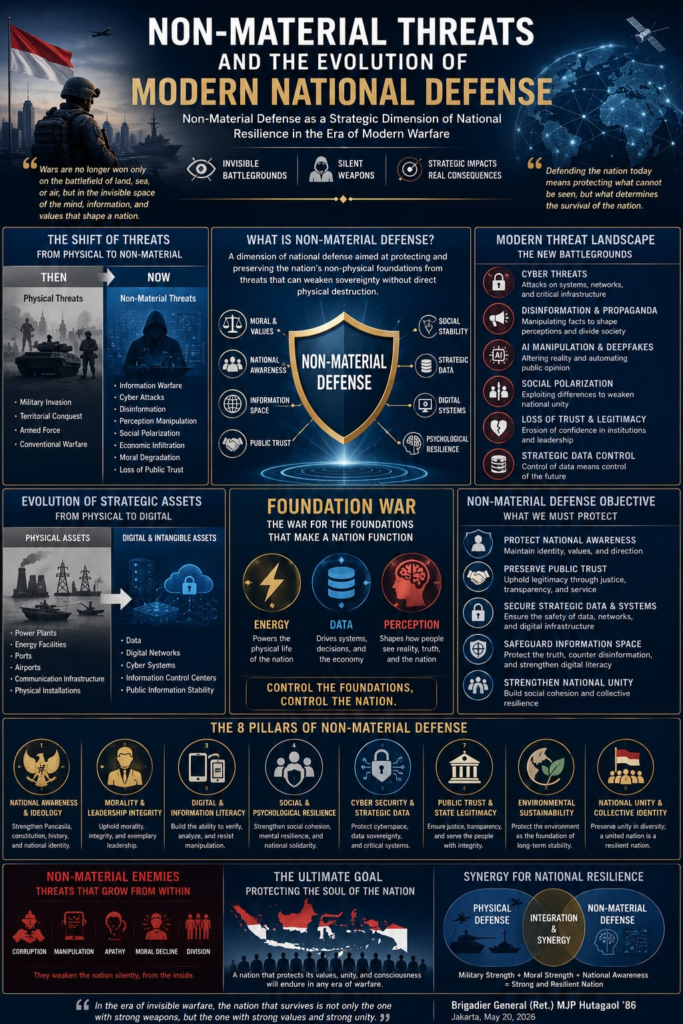
In the context of national resilience and defense, non-material dimensions include:morality,collective awareness,values,public trust,social psychology,national unity,information space,public perception,and the direction of national consciousness.
Although intangible, these dimensions have real and direct impacts on national stability because they influence legitimacy, public behavior, and collective social cohesion.
In the modern era, threats no longer appear solely in the form of conventional military aggression. They also emerge through:information manipulation,perception warfare,disinformation,cyber attacks,social polarization,moral degradation,and the weakening of public trust toward state institutions.
In this context, Non-Material Defense may be understood as:
“A dimension of national defense aimed at protecting and preserving the nation’s non-physical foundations — including collective morality, national awareness, information space, public trust, social stability, strategic data, and digital systems — from threats capable of gradually weakening national sovereignty without direct physical destruction.”
If physical defense protects territory, military assets, and strategic infrastructure, then non-material defense protects the invisible foundations that sustain the continuity of the nation itself.
Modern security studies increasingly recognize that national security is no longer limited to conventional military defense, but now extends into cyber security, information security, social resilience, and psychological endurance.
II. THE SHIFTING NATURE OF MODERN THREATS
Technological advancement has transformed the character of global conflict.
Wars no longer begin solely with troop mobilization, but often through opinion manipulation, narrative warfare, cyber attacks, economic infiltration, data control, and the shaping of public perception.
In many modern cases, nations experience instability not because they lose militarily, but because they lose public trust in their institutions.
The collapse of the Soviet Union demonstrated that even a military superpower could disintegrate when economic foundations, ideological legitimacy, and public confidence eroded over time.
The breakup of Yugoslavia showed how identity conflict, social polarization, and the collapse of collective national consciousness could destroy a nation from within.
Indonesia’s multidimensional crisis in 1998 also illustrated how economic pressure, social unrest, crisis of legitimacy, and information instability could rapidly destabilize national order.
The Arab Spring later demonstrated how social media and digital information flows could accelerate mass mobilization and political change within a very short time.
Today, the rise of Artificial Intelligence opens new possibilities for reality manipulation through deepfakes, digital propaganda, and automated public opinion engineering.
Indonesia itself faces similar challenges:social polarization,information overload,hoaxes,digital radicalization,online gambling,narcotics networks,resource exploitation,and weakening public trust in institutions.
All of these indicate that modern threats increasingly target the foundational layers of national life:trust,identity,collective awareness,data,and public perception.
III. FROM PHYSICAL DEFENSE TO NON-MATERIAL DEFENSE
Constitutionally, the primary duties of the Indonesian National Armed Forces (TNI) are regulated under Law Number 34 of 2004 concerning the TNI.
However, in response to the changing global strategic environment, the law was revised through Law Number 3 of 2025 regarding Amendments to Law Number 34 of 2004.
This means that the 2004 Law remains the primary legal foundation, while strategic adjustments were introduced to accommodate evolving modern threats.
One important evolution occurred within Military Operations Other Than War (OMSP).
Initially consisting of 14 operational tasks, OMSP expanded into 16 tasks under the 2025 revision, including:
Assisting in countering cyber defense threats.
Assisting in protecting Indonesian citizens and national interests abroad.
This shift reflects a significant strategic realization:threats to sovereignty are no longer limited to conventional military aggression, but have expanded into cyberspace, information warfare, psychological operations, and other non-physical dimensions.
IV. THE EVOLUTION OF STRATEGIC OBJECTS IN THE DIGITAL ERA
Under Indonesian law, National Vital Objects were historically defined as physical infrastructures essential to public life and state interests:power plants,energy facilities,ports,airports,communication infrastructure,and other strategic installations.
However, digital transformation has fundamentally changed the structure of modern states.
Today, governance, economic systems, communications, defense structures, and social interactions increasingly depend on:data,digital networks,cyber systems,information control centers,and public information stability.
Although the original legal definition of National Vital Objects focused on physical infrastructure, modern threats demonstrate a gradual strategic shift toward non-physical dimensions.
The inclusion of cyber defense threats within OMSP in 2025 indicates that digital systems, information networks, and cyberspace now possess strategic value directly related to national sovereignty and stability.
As a result, strategic thinking regarding vital national assets must evolve from purely physical infrastructure toward the non-physical systems that sustain the functioning of the modern state.
In this context, data, digital systems, information networks, and public perception have become strategic national assets.
When data systems collapse, communications are disrupted, or public information spaces are overwhelmed by disinformation, national stability can be shaken without a single shot being fired.
This is where modern defense enters a new dimension:the defense of non-physical national foundations.
V. NON-MATERIAL ENEMIES: THREATS GROWING FROM WITHIN
One defining characteristic of non-material threats is that they do not always originate externally.
Very often, they grow from within the nation’s own system.
When justice weakens, corruption becomes normalized, information manipulation evolves into culture, greed is institutionalized, and environmental destruction is tolerated, the nation gradually experiences erosion of its foundational resilience.
These are what may be called non-material enemies.
They do not always appear as armed organizations or foreign powers. They may emerge as:systemic manipulation,loss of leadership integrity,moral degradation,erosion of public trust,and weakening national consciousness.
Over time, such threats can become even more dangerous than physical attacks because they silently destroy national resilience from within.
VI. INFORMATION SPACE, PERCEPTION WARFARE, AND FOUNDATION WAR
The digital era has transformed information into a strategic instrument of power.
Within this context emerges what may be understood as Foundation War — a form of modern conflict that no longer merely attacks systems on the surface, but seeks to control the foundations that enable a nation to function.
These foundations consist of:energy,data,and perception.
If energy controls the physical life of a nation, and data controls information systems and decision-making processes, then perception controls how society interprets reality, truth, and political direction.
Modern conflict therefore no longer focuses solely on territory, but increasingly on:information flows,public emotions,social trust,and collective national consciousness.
Hoaxes, digital propaganda, algorithmic manipulation, and narrative warfare can generate:panic,hatred,social fragmentation,and mass distrust.
As a result, information space has become a strategic battlespace in modern defense.
Non-material defense therefore requires:digital literacy,moral education,psychological resilience,and the capacity to maintain clarity of thought amidst the explosion of global information.
VIII. THE EIGHT PILLARS OF NON-MATERIAL DEFENSE
To address these challenges, non-material defense requires operational foundations capable of strengthening modern national resilience.
These eight pillars include:
National Awareness and Ideology
Morality and Leadership Integrity
Digital and Information Literacy
Social and Psychological Resilience
Cyber Security and Strategic Data Protection
Public Trust and State Legitimacy
Environmental Sustainability and Living Space Protection
National Unity and Collective Identity
Together, these pillars demonstrate that modern defense no longer depends solely on military strength, but also on the ability to preserve the invisible foundations sustaining national continuity.
IX. NON-MATERIAL DEFENSE AS THE EVOLUTION OF DEFENSE DOCTRINE
The changing era demands an evolution in strategic thinking.
If defense once centered primarily on territory and physical force, modern defense must now also encompass:digital space,social space,moral space,psychological space,and national consciousness.
Non-material defense is not a replacement for military defense, but a strategic complement necessary for confronting multidimensional modern threats.
Because in reality, nations often collapse not merely because they lose wars, but because they lose direction, morality, legitimacy, and unity.
Within this context, non-material defense represents an important dimension in the evolution of modern national defense doctrine.
X. CONCLUSIONPROTECTING THE SOUL OF THE NATION
True defense is not found solely in weapons and military power, but also in:justice,leadership integrity,morality,unity,and collective national awareness.
Bombs may destroy buildings.Cyber attacks may paralyze systems.But moral collapse and the loss of public trust can paralyze the future of a nation itself.
Therefore, protecting non-material defense means protecting the soul of Indonesia.
In an era of increasingly invisible warfare, the nations that endure will not merely be those strong militarily, but those capable of preserving their morality, collective awareness, unity, and civilizational direction.
Brigadier General (Ret.) MJP.Hutagaol
